
E-Signatures with Defensible Proof
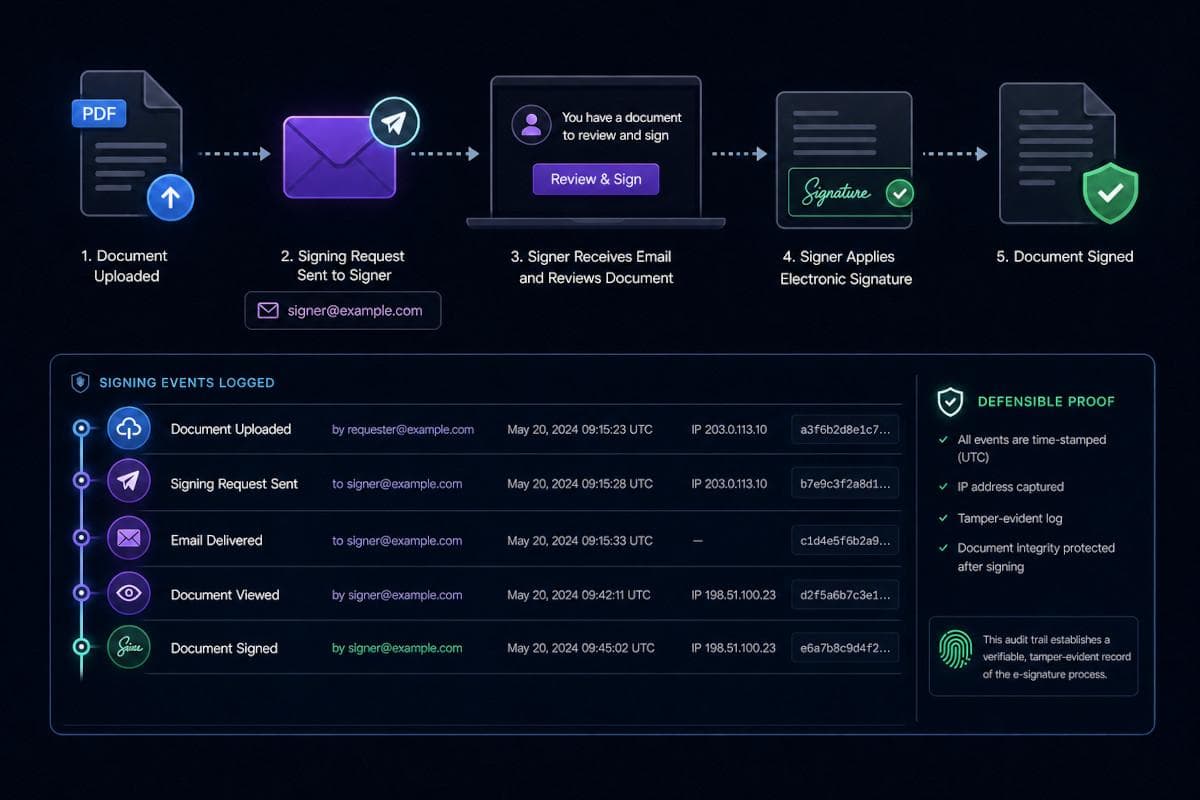
How to speed up signing workflows without compromising evidentiary value
Document signing remains one of the slowest parts of legal work and business transactions. Drafts move quickly by email or messaging apps, but execution often stalls. A client needs to print, sign, scan, and resend. A counterparty misses a page. A version changes after circulation. A witness signs the wrong draft. Then, when a dispute arises, the real question is no longer whether a signature appears on the document, but whether the team responsible can prove who signed it, what they signed, and when they signed it.
That is where e-signatures become truly useful—not just as a convenience, but as part of a more defensible signing and recordkeeping workflow.
In Nigeria, the conversation should not simply be about “going paperless.” It should be about reducing friction while preserving proof. A modern e-signature workflow should help teams show the integrity of the document, the identity of the signatory, the time of signing, and the history of the signing process. In practice, this means organizations need more than a digital scribble on a PDF. They need defensible proof.
The problem with basic digital signing workflows
A lot of what passes for e-signing today is little more than image placement. Someone pastes a signature onto a document, types their name into a PDF, or clicks approval in an email trail. While these methods may appear efficient, they often leave important evidentiary gaps.
If the document is later challenged, several questions can arise:
- Was this the exact version that was approved?
- Who actually applied the signature?
- Was the signer properly identified?
- Did the document change after execution?
- Is there a reliable audit history showing what happened?
These questions matter because signing workflows are not just about convenience—they are about managing risk. A process that saves time but creates uncertainty may ultimately cost more in disputes, rework, failed approvals, or enforcement problems.
What defensible proof should include
A defensible e-signature workflow should do more than capture consent. It should preserve evidence around the act of signing.
At a minimum, a reliable e-signature system should help establish:
- Signer identity – who was invited to sign and how they were linked to the signing process
- Document integrity – whether the signed version remained unchanged
- Timestamping – when each signing event occurred
- Auditability – a record of views, actions, completions, and workflow events
- Version control – confidence that the final signed document is the right one
- Secure retention – the ability to store and retrieve the signed record later
This is the difference between a signature that merely looks valid and one supported by records that can be explained to a client, counterparty, regulator, auditor, or court.
Why this matters in Nigerian business and legal practice
Across Nigeria, legal teams, compliance teams, and businesses increasingly work through fast-moving commercial transactions, internal approvals, remote onboarding, employment documentation, advisory mandates, and cross-border matters. In all of these contexts, execution delays create friction. Clients want speed. Legal teams want certainty. Businesses want cleaner workflows.
E-signatures can help reduce delays in:
- engagement letters
- NDAs and confidentiality undertakings
- board and internal approvals
- commercial agreements
- employment and HR documentation
- compliance attestations
- routine client authorizations
But the need for speed does not reduce the need for proof. If anything, remote workflows make proof more important. Where parties are not physically present, the quality of the digital record becomes central.
In practical terms, the issue is not whether digital execution is convenient. It is whether the method used can support a credible evidentiary position if challenged later.
Managing risk in e-signature workflows
Legal, compliance, and business teams should think about e-signatures as part of document risk management. The goal is not only to complete a transaction faster, but to do so in a way that creates a stronger record.
That means teams should be able to answer:
- Who prepared and circulated the final version?
- Who was invited to sign?
- In what order did parties sign?
- What evidence exists of delivery and completion?
- How is the executed version stored?
- Can the document’s history be shown later?
The stronger the answers to these questions, the more reliable the workflow becomes.
What to avoid in digital signing workflows
Not every digital signing process is suitable for important legal, compliance, or business records. Teams should be cautious about workflows that rely on:
- unsigned drafts circulated informally over chat
- signature images pasted onto editable documents
- missing audit trails
- unclear version histories
- shared login access or weak identity controls
- signed documents stored in scattered email threads
These practices may feel expedient, but they can create serious uncertainty later—especially where the document becomes material to a dispute, investigation, transaction review, audit, or compliance process.
A better approach: speed plus proof
The right e-signature workflow should let teams request electronic signatures from clients, counterparties, employees, or internal stakeholders without turning execution into an administrative bottleneck. But it should also preserve the surrounding proof that gives the signed document credibility.
In practical terms, a defensible signing workflow should enable teams to:
- send signature requests electronically
- track signature status in real time
- preserve an audit trail of signing events
- keep the executed version securely stored
- reduce version confusion
- retrieve signed records easily when needed
This is especially valuable for law firms, in-house legal teams, compliance teams, HR teams, finance teams, and regulated businesses handling multiple documents and approvals at once. Instead of chasing signatures manually, teams can manage execution with more structure and less friction.
Why this matters for service and operations
Clients, counterparties, employees, and internal stakeholders increasingly expect document workflows to be responsive, digital, and efficient. They do not want avoidable delays in routine approvals, onboarding, or contract execution. A team that can move documents to signature quickly—while maintaining a reliable record—delivers a better experience and reduces execution friction.
That improves:
- turnaround time
- matter and workflow efficiency
- internal coordination
- stakeholder confidence
- execution readiness
Better signing workflows also help teams spend less time on administrative follow-up and more time on higher-value work.
E-signatures are not just about convenience
It is easy to frame e-signatures as a productivity feature. But for legal, compliance, and regulated workflows, that framing is incomplete. E-signatures are also about defensibility.
The concern should never end at whether a document was signed. The more important question is whether the signing process produced a record that can stand up to scrutiny. When the answer is yes, e-signatures become more than a convenience—they become part of sound operational and legal control.
How Lexkeep helps
Lexkeep helps legal, compliance, and regulated teams request electronic signatures, reduce signing delays, and keep signing records organized and easier to defend.
With a workflow built for legal and regulated use cases, Lexkeep supports a more reliable way to manage execution by helping teams:
- send documents for signature electronically
- reduce back-and-forth and execution delays
- maintain clearer signing records
- keep signed documents securely stored
- improve retrieval and matter organization
The value is simple: faster execution without sacrificing control.
Conclusion
In modern practice, speed matters—but proof matters more. The best e-signature workflow is not the one that merely gets a document signed. It is the one that helps teams show who signed, what was signed, when it was signed, and that the record remained intact. That is what makes an e-signature workflow defensible.